Education City is not a conventional sightseeing district. It is a twelve-square-kilometre campus where universities, a national library, a modern-art museum, mosques, parks, sports venues and public programmes share one landscape. The visitor's reward comes from following an idea across institutions, not collecting photographs of disconnected buildings.
A useful first visit joins Qatar National Library with either Mathaf or Oxygen Park, using the Education City tram or walking routes as conditions allow. University and institutional buildings are active workplaces, so public access must be checked rather than assumed. The campus website and each venue remain the authority for current entry and programmes.
At a glance
Start here
- Treat Education City as a campus with public destinations, not an open architectural theme park.
- Use QNL as the orientation anchor and add either Mathaf or Oxygen Park.
- Check the Education City map and current tram information before crossing the campus.
- Enter academic or religious venues only through clearly public programmes and visitor routes.
01
Understand the campus scale
Education City's official visitor page describes a twelve-square-kilometre area containing learning, culture, sport, parks and dining. Its list of places includes Qatar National Library, Education City Mosque, Oxygen Park, Mathaf, Al Shaqab, Education City Stadium and university campuses. That variety can make the destination appear more compact than it is.
Choose a theme before a route. A knowledge theme pairs QNL with a public lecture; a modern-art theme centres Mathaf; a landscape theme combines the library with Oxygen Park. Architecture can connect all three, but it should not become permission to enter every building. The campus is lived and worked in, not staged solely for visitors.
Sources: Qatar Foundation02
Arrive with an internal route
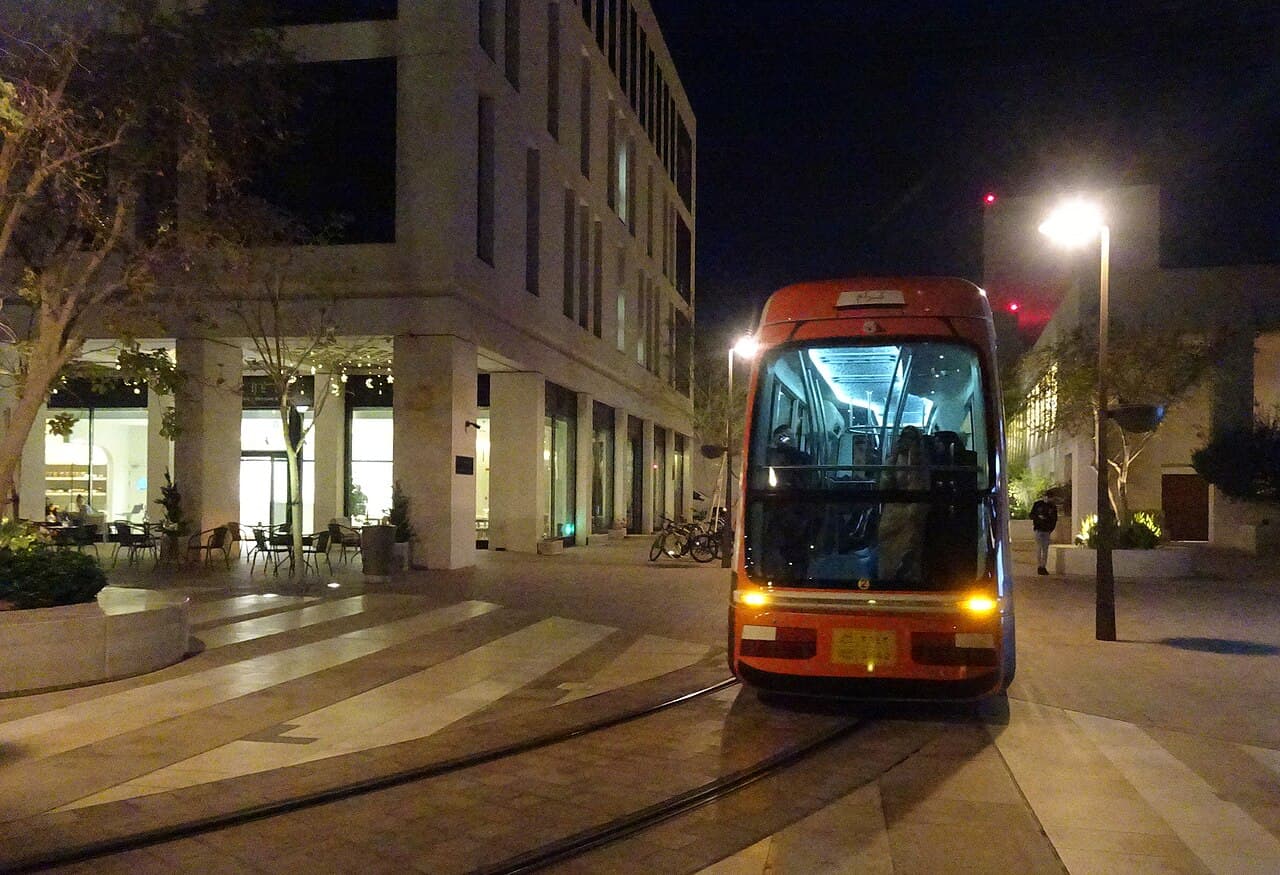
Education City has metro access and its own internal transport. The official getting-around page lists Al Shaqab, Qatar National Library and Education City metro stations, while the Education City Tram connects destinations on Yellow, Blue and Green lines. Its interactive map shows landmarks, tram lines, bus stops and walking or running trails.
Use the map to connect named stops, then check the current schedule rather than reproducing it from this article. Campus services can change by weekday, event or operational need. Save a walking alternative for short links and a clear pickup point for the return, especially if the final venue closes before the wider campus.
- Pick the metro station closest to the first venue, not the campus in general.
- Save the internal tram stop names for both directions.
- Recheck the return before entering the last building.
03
Make QNL the public anchor
Qatar National Library is the easiest institution through which to understand Education City's public mission. Its visitor page places it on the Metro's Green Line and explains connections with the Education City tram. The library is more than a striking interior: it is a working national, research and public library with spaces for different ages and uses.
Arrive with a modest task. Browse a subject connected to the trip, examine current public displays, or use the Children's Library if travelling with young readers. QNL's children and young-adult space offers more than 100,000 books, educational toys and learning programmes, but a specific event should be confirmed on the live calendar.
Sources: Qatar National Library; Qatar National Library04
Use Mathaf to question modernity
Mathaf: Arab Museum of Modern Art gives the campus an argument about who defines modern art. Its permanent collection joins artistic histories from Arab societies with work from the wider Middle East and places historically linked to Qatar and the Arabian Peninsula. The galleries address colonialism, nationhood, oil, cities, gender, ecology and competing ideas of progress.
That makes Mathaf more than the cultural add-on to a university district. It asks how art records the political and social changes that institutions of education also study. Read the current gallery notice before travelling: displays rotate and particular rooms can close, so the museum's interpretive framework is more reliable than a checklist of named works.
Sources: Mathaf: Arab Museum of Modern Art05
Read Oxygen Park as infrastructure
Oxygen Park is designed as more than decorative green space. Visit Qatar describes varied topography that channels wind, paths moving between upper and lower areas, gardens, picnic areas, jogging trails and sports fields. Covered walkways include cooling measures, showing how landscape design responds to activity and climate.
Do not turn that design response into a claim that conditions are always comfortable. Visit only when the live weather and your own tolerance support it. When they do, compare the park's slopes, shade and movement routes with the controlled interior of QNL. Both are forms of learning infrastructure, one organised around collections and the other around bodies in landscape.
Sources: Visit Qatar06
Respect the working institutions
Education City includes universities, research centres and religious spaces whose public roles vary. A building listed as a landmark is not automatically open for unscheduled interior tourism. Use advertised exhibitions, lectures, tours and visitor information as the invitation. If the public route is unclear, enjoy the exterior from established paths or choose QNL, Mathaf or a park instead.
The same principle improves architectural observation. Notice how buildings create thresholds, courtyards, shade and relationships with the tram or landscape without treating students and staff as background characters. A curious visitor can learn from an active campus while accepting that access is part of the institution's function, not an obstacle to overcome.
Sources: Qatar Foundation07
Choose a two-anchor itinerary
For a learning-and-art visit, begin at QNL, use the internal network to reach Mathaf, and stop after the museum. For a family or landscape visit, begin at the Children's Library and add Oxygen Park only if conditions suit. For an event-led visit, let the confirmed lecture, performance or tour be the first anchor and choose just one nearby public institution.
These routes are editorial suggestions, not official itineraries. Check each venue independently because the wider campus can remain accessible while a particular institution follows different hours or entry procedures. The successful day leaves you with one connection between knowledge, art and place, not proof that you crossed all twelve square kilometres.
- Knowledge and art: QNL plus Mathaf.
- Family and landscape: Children's Library plus conditional Oxygen Park.
- Public programme: confirmed event plus one nearby venue.
Useful answers
Reader questions
Can tourists visit Education City?
Education City promotes public destinations including QNL, Mathaf and Oxygen Park, but each institution controls its own access. Use public visitor pages and programmes rather than assuming every university or mosque interior is open.
Sources: Qatar FoundationHow do visitors move around the campus?
The campus has metro stations, an Education City Tram, buses and designated paths. Use the official interactive map and current schedule because the internal network and venue hours can change.
Sources: Qatar FoundationWhat is the best first pairing in Education City?
QNL and Mathaf make the strongest all-indoor intellectual pairing: a working national library followed by a museum that examines modern and contemporary art through Arab and regional histories.
Sources: Qatar National Library; Mathaf: Arab Museum of Modern ArtIs Oxygen Park always a heat-safe option?
No. Its design includes varied terrain, wind-channeling and cooled covered routes, but you must still judge current weather, shade and personal tolerance. Treat the park as optional when conditions are demanding.
Sources: Visit QatarRead the evidence
Sources and further reading
These sources support the relevant sections above. Plans and comparisons are editorial suggestions. Check operators for current arrangements.
- A Destination for Learning and Entertainment in Qatar | Education City ↗Qatar Foundation · Accessed 14 September 2026
Education City's scale and mix of universities, library, museum, mosque, parks, sports and public activities.
- Transportation Options in Qatar | Education City ↗Qatar Foundation · Accessed 14 September 2026
Metro stations, internal tram lines, wayfinding map, paths and the instruction to check individual venue hours.
- Hours and Location | Qatar National Library ↗Qatar National Library · Accessed 14 September 2026
QNL's Education City location and connections by Green Line and Education City tram.
- Explore the Children's Library | Qatar National Library ↗Qatar National Library · Accessed 14 September 2026
The Children's Library audience, 100,000-plus books, educational resources and programme types.
- About the Galleries - Mathaf ↗Mathaf: Arab Museum of Modern Art · Accessed 14 September 2026
Mathaf's regional collection scope and themes of modernity, colonialism, nationhood, cities and social change.
- Oxygen Park Doha | Visit Qatar ↗Visit Qatar · Accessed 14 September 2026
Oxygen Park's landscape design, trails, sports spaces, gardens, topography and cooling features.